Piazza del Centauro, Pietrasanta
Posted in: Day Trips Localities Lucca Museums & Galleries Must See Attractions Tourist Attractions
Pietrasanta is an incredibly picturesque Tuscan town that is a must for art-lovers who are interested in getting off the beaten path while exploring the region. Of course, destinations such as Florence, Pisa, and Siena will all yield all sorts of truly extraordinary and world-class museums and galleries but there are many other important towns and cities throughout the region that have rich cultural histories and in which some of the most famous names worked and the most astounding pieces of art are on display. So, if you have found a villa with pool in Lucca and you are looking to take in amazing works of art and learn about great Renaissance masters, be sure to set aside a day to visit Pietrasanta, which is basically one large, open-air museum dotted with artistic gems.

Though the town has ancient Roman origins, it was one of the ideal towns of Tuscany founded in the 13th century that were created based on plans involving perfect proportions, symmetry, and balance, and the historic core of Pietrasanta is made up of five main streets running parallel to each other with a large square at one end. Made particularly famous once Michelangelo noticed the beauty of the stone from the area and began to use it, the town is located close to the famous marble quarries of Carrara and, as a result, has been a beacon for sculptors and artists for centuries, since at least the late Middle Ages.
Posted in: Localities Lucca Museums & Galleries Must See Attractions Tourist Attractions
Tuscany, as a region with an unbelievably rich cultural and artistic heritage is, unsurprisingly, home to many palaces, art museums, civic museums, churches, and religious collections that stuffed full of extraordinary works of art from throughout history. However, in addition to the old, the region also celebrates the new in contemporary art galleries and various other kinds of art spaces and the art scene is still very much alive and well. So, if you have found a luxury villa in Tuscany and you are interested in art, then be sure to seek out these newer institutions as well to dive into the current art scene and to experience it in real time for yourself! If you were considering a villa with pool in Lucca, in particular, and you are interested in more recent artistic innovations and practices, then you should definitely head to the ARKAD Foundation.

Located in the town of Seravezza, in an old marble sawmill across from the Medici Palace in town, the ARKAD Fondazione, or ARKAD Foundation, is a wonderful intercultural centre that promotes the creation of art and the spread of culture. Nestled between the Apuan Alps and the Versilia plain, this little town is an impossibly scenic part of the world – think lush hillsides covered in trees, towering peaks, verdant valleys swathed in morning fog, a silver river slicing through the town, and pretty streets lined with stone buildings and palm trees - and it seems fitting, therefore, that it is home to a space producing beautiful and fascinating works of art.
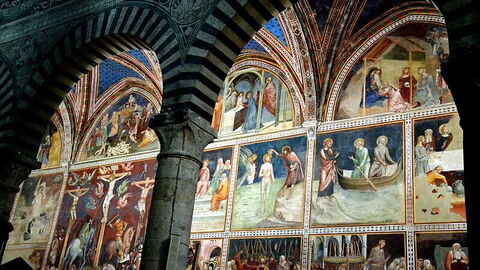
Frescoes, Collegiata
Posted in: Churches & Religious Buildings Localities Museums & Galleries San Gimignano Tourist Attractions
While there is no shortage of beautiful churches in Tuscany to be explored there are some that are especially wonderful architectural gems and full of exceptional works of art. One of the most particularly noteworthy examples among these is the Collegiate Church of Santa Maria Assunta in San Gimignano, which is a truly magical gem. Just find a vacation rental in San Gimignano and then come and discover the lush interiors and amazing works of art hidden within the city's spectacular Duomo.

Home to fresco cycles by notable Italian masters including Domenico Ghirlandaio, Benozzo Gozzoli, Taddeo di Bartolo, Lippo Memmi and Bartolo di Fredi, this incredible church is nestled in the very pretty UNESCO-awarded historic centre of San Gimignano and the frescoes themselves are also on the UNESCO World Heritage List and noted as, "works of outstanding beauty".
Posted in: Florence Localities Museums & Galleries Must See Attractions Tourist Attractions
Tuscany's most famous scientist is probably Galileo Galilei, the beloved astronomer, physicist, and engineer who was from Pisa and famously sentenced to live the rest of his life under house arrest after angering the Catholic Church with his theory of Copernican heliocentrism (which states that the earth rotates daily and revolves around the sun). Later pardoned and eventually honoured by the Vatican, centuries after his death, Galileo has been credited as one of the forefathers and instigators of modern science and his work still informs research and education today. For those interested in science and Galileo who are browsing our luxury villas in Florence, it is worth keeping in mind that this fascinating and culturally vibrant city is home to the Museo Galileo. Not only is it a wonderful place to learn more about the Tuscan visionary, it boasts one of the world's major collections of scientific instruments, making it a must-see for those with STEM-related interests!

The Museo Galileo (previously the Istituto e Museo di Storia della Scienza or Institute and Museum of the History of Science) is located in Piazza dei Giudici in Florence, just a stone's throw from the Uffizi Gallery, making it very easy to have a museum day during your vacation in Florence in which you visit both! Housed in the 11th century Palazzo Castellani, once known as the Castello d’Altafronte, the museum was renamed and re-opened to the public in 2010 after being closed for two years for renovations and restructuring of the museum. Established as the Istituto e Museo di Storia della Scienza in 1930 by the University of Florence, the basis of the collection comes from the estates of the Medici and the Lorraine dynasties but has since been added to and expanded.
Posted in: Curiosities Museums & Galleries Must See Attractions Tourist Attractions
It was not enough for the wealthy and educated noblemen and merchants of Europe to display their money, influence, and power, they also wished to show off their erudition and good taste. One of the ways that they began to do this was with the Cabinet of Curiosities, or Wunderkammer. Developed in the 16th century, though more rudimentary sorts of private collections had existed among such people earlier, these were rooms of collections of items that showcased an interest in art, learning, and the natural world. Objects that were part of such collections ranged from prints and drawings to books and manuscripts, from taxidermied animals and bones to shells and stones. The wealthier had larger and more elaborate collections in bigger rooms while less wealthy individuals had smaller amounts of objects in studies or even cases or cabinets. A form of entertainment, in addition to being an indicator of socioeconomic status, these collections were shown off to friends, guests, and business partners when visitors were over.

With the dawning of more official museums, many such collections were dissolved and sent to public institutions or sold. As such, this eccentric and eclectic form of display largely fell out of favour in order to make way for the more organised and standardised methods employed by professionals. However, if you have found a vacation rental in Arezzo and are interested in experiencing the sensory overload and highly personal curation of a cabinet of curiosities for yourself, there is one to be viewed in town; the Theatrum Mundi.