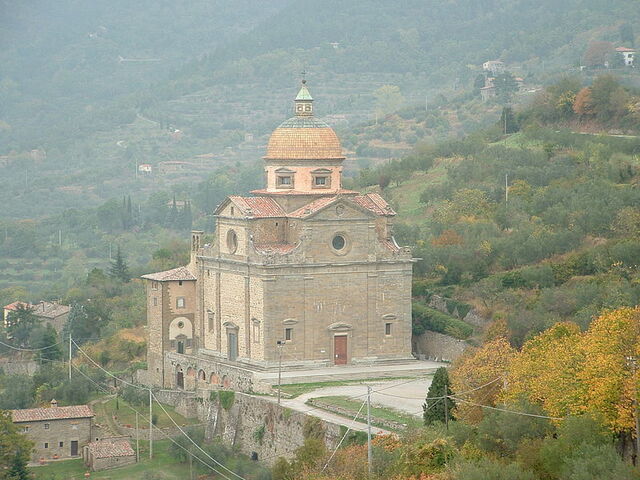
Cortona is a charming medieval hilltown in Tuscany which is an important artistic and cultural centre. Within the walls of the town, it can sometimes seem as though time has stopped long ago and everywhere you turn, you will see historic architectural gems. However, some of the real highlights of the town and its surrounding area are its churches. The Church of Santa Maria Nuova, in particular, as a centralised square-plan Renaissance church, is a prime example of an important principle of Renaissance construction. Santa Maria Nuova was built by Giorgio Vasari in 1554 and is an example of one of that great architect’s later works. If you’re an architecture lover and have found a luxury villa in Cortona, be sure to stop by and check it out.
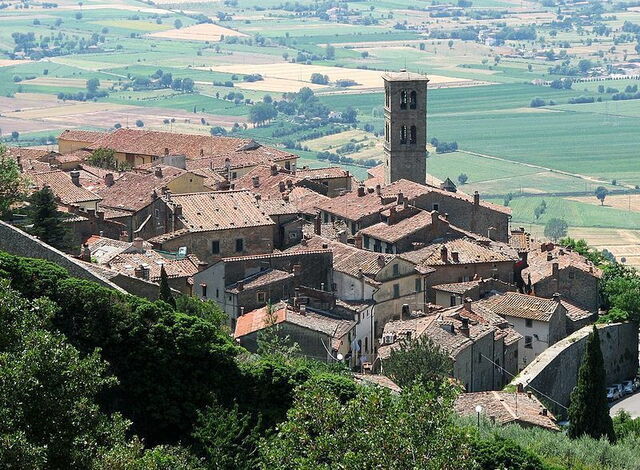
The church of Santa Maria Nuova is located just outside of the walls of the town of Cortona, in Tuscany, Italy. It is built on a Greek cross plan and is surmounted by a main cupola which was only finished during the 17th century, a wonderful example of such a centralised design. Built to house a miraculous image of the Virgin that previously had been in a private chapel, work was begun in 1550 and the church was consecrated in 1610. The work originally began based on designs by Cristofanello from Cortona but his death brought a shift. Giorgio Vasari was commissioned and the design changed to the classic Renaissance style temple based on Greek cross plan that we see today. Shortly after construction was begun, Vasari departed for Florence to work on the Palazzo Vecchio, so other masters were brought in to oversee the project, though he returned occasionally to tweak and check on it.
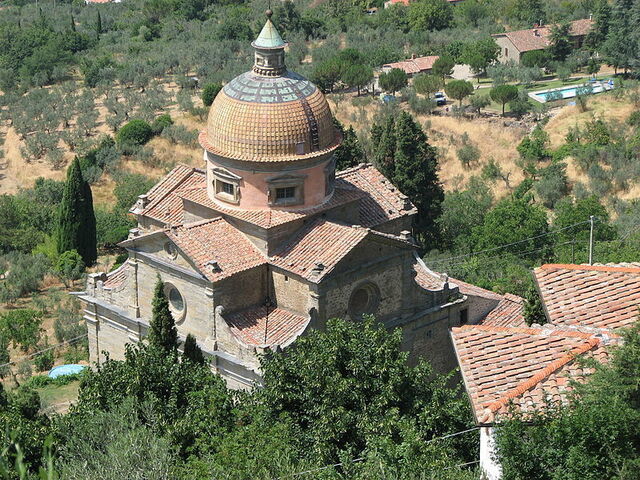
Inside are four large columns which support the lantern of the cupola each of the arms branches into barrel-vaulted wings, each topped by a smaller cupola. The high altar was completed by local artist Bernardino Radi while a second altar to the right of the entrance holds a 16th century altarpiece by Alessandro Allori, depicting the Birth of the Virgin Mary. Other works include San Carlo Borromeo Bringing the Eucharist to Plague Victims by Baccio Ciarpi, and the Annunciation by Empoli. The 16th century Rosette window on the facade was designed by Urbano Urbani and depicts an Adoration of the Magi.
A trip to Cortona isn't complete without a look at this attractive building in a lovely setting. However, the church is in poor condition, and is not open for sightseeing or inspection. You still may view the outside and the surrounding scenery but you’ll probably only get inside if you’re lucky. Still, it’s worth paying a visit to this little gem if you’re visiting this corner of Tuscany.
A trip to Cortona isn't complete without a look at this attractive building in a lovely setting. However, the church is in poor condition, and is not open for sightseeing or inspection. You still may view the outside and the surrounding scenery but you’ll probably only get inside if you’re lucky. Still, it’s worth paying a visit to this little gem if you’re visiting this corner of Tuscany.
Photo credits
Picture 1: LigaDue / CC BY 3.0;
Picture 2: Patrick Denker / CC BY 2.0;
Picture 3: Patrick Denker / CC BY 2.0
Picture 1: LigaDue / CC BY 3.0;
Picture 2: Patrick Denker / CC BY 2.0;
Picture 3: Patrick Denker / CC BY 2.0