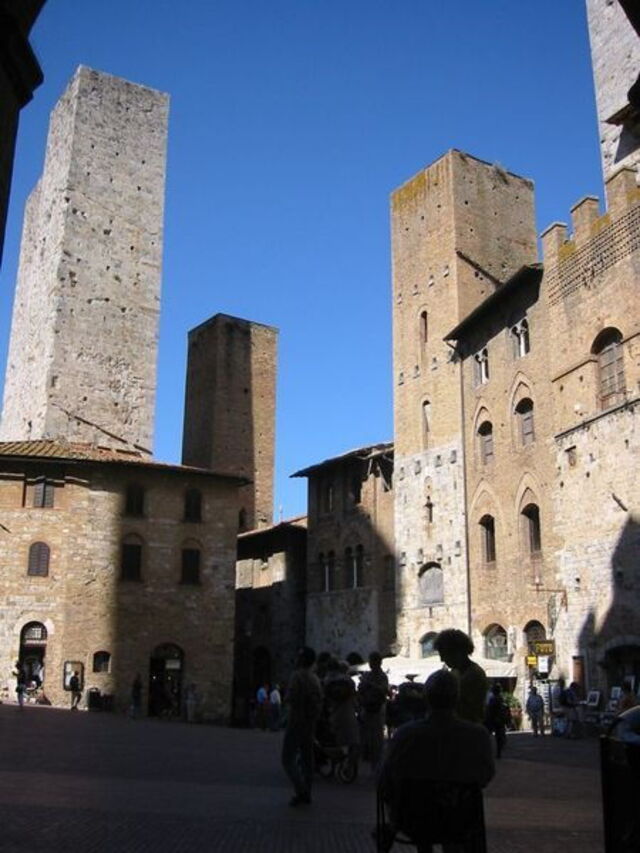
Well known as a tourist attraction in and of itself, San Gimignano attracts a multitude of visitors each and every year. Some decide to stay in and around the town, looking for that small town appeal, while others make a day trip of it from one of the larger towns such as Florence and Siena. No matter what way you decide to visit, San Gimignano is a beautiful site to see. Its many towers seem to rise majestically from the landscape as you approach it.
San Gimignano is a small medieval town about 60km southwest of Florence, 70km to the western coast of Italy, and 40km from Siena. Founded by the Etruscans in the third century B.C., the town has gone from a small hamlet to a major stopping point for traders to a small tourist town well known for the wine that is grown in its region. In the middle ages the town suddenly found itself on the Via Francigena, a main road running to Rome from France and much of Europe.
San Gimignano is a small medieval town about 60km southwest of Florence, 70km to the western coast of Italy, and 40km from Siena. Founded by the Etruscans in the third century B.C., the town has gone from a small hamlet to a major stopping point for traders to a small tourist town well known for the wine that is grown in its region. In the middle ages the town suddenly found itself on the Via Francigena, a main road running to Rome from France and much of Europe.
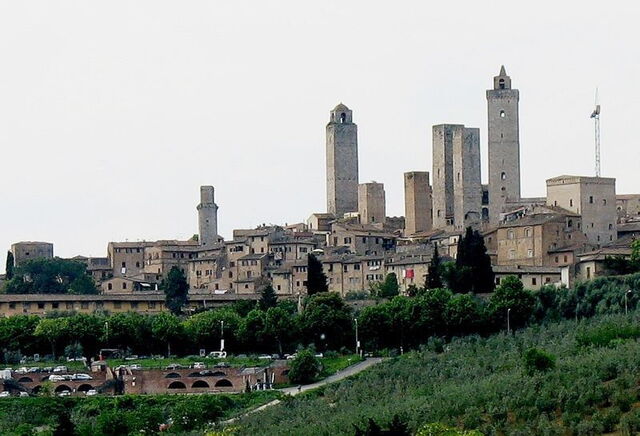
This provided a steady stream of pilgrims passing through on their way to Rome, which allowed it to become a major trading post for merchants. The fertile hills that surround San Gimignano only added to its trading appeal with its abundant and high quality agricultural products.
These ideal conditions enriched parts of the populace, and with this new wealth they decided to build bigger and better homes for themselves. As the rather constrictive city walls did not allow for much outward expansion, there was only one way to go: Up.
So the many wealthy merchant families that resided in San Gimignano began to construct tall and elaborate towers, like many of Tuscan hill towns at the time. It became somewhat of a competition between the families, who had the biggest and best tower in town. While most of these towers across Tuscany have seen their end come too soon due to war, disuse, or natural disasters, San Gimignano's towers still stand tall today. Many of them are open to the public to climb and offer views of the surrounding hills and valleys that have to be seen to be believed.
These ideal conditions enriched parts of the populace, and with this new wealth they decided to build bigger and better homes for themselves. As the rather constrictive city walls did not allow for much outward expansion, there was only one way to go: Up.
So the many wealthy merchant families that resided in San Gimignano began to construct tall and elaborate towers, like many of Tuscan hill towns at the time. It became somewhat of a competition between the families, who had the biggest and best tower in town. While most of these towers across Tuscany have seen their end come too soon due to war, disuse, or natural disasters, San Gimignano's towers still stand tall today. Many of them are open to the public to climb and offer views of the surrounding hills and valleys that have to be seen to be believed.
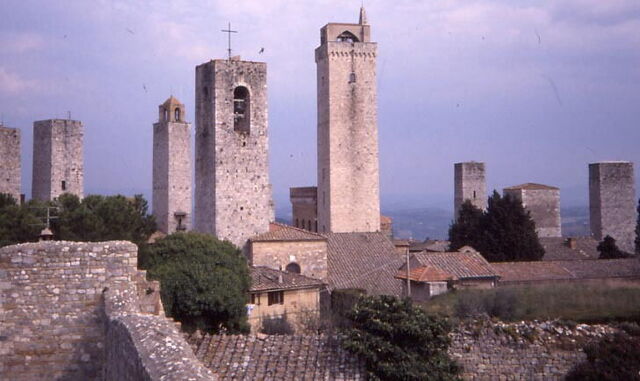
Though they are clearly evident from far away, the towers are hardly the only thing to see in San Gimignano. The town also has a 14th century fortress, La Rocca, that is now in ruins but has been made into a public park, and makes a great place for a picnic with a commanding view of the surrounding area. For a darker mood, there is a medieval torture museum in town with many gruesome devices used long ago. The Museum of Sacred Art will help cleanse your cultural palate after that as it houses a sizable collection of religious art and illuminated manuscripts. La Collegiata is San Gimignano's Duomo, a large 11th century cathedral well known for its frescoes.
The region is also well known for its wine, specifically the Vernaccia di San Gimignano, a full-bodied white wine that has been considered Italy's finest white for hundreds of years. A well made Vernaccia will have a crisp, rich flavor that will linger on the palate. Occasionally described as a red wine made from white grapes, it is well worth a visit to one of the many vineyards in and around San Gimignano. In 1966 it was the first white wine awarded DOC status, and has since been upgraded in 1993 to DOCG.
Whether you drive or take a bus there, you will have to park outside the city and walk in. Though this is for the best as San Gimignano, like most Tuscan hill towns, is best explored on foot. Those who elect to stay in this beautiful town will be able to enjoy the town in the evenings, when the majority of the tourists leave for the larger cities.
Day trip or vaction residence, San Gimignano is a fascinating smaller town that you will be sure to enjoy!
The region is also well known for its wine, specifically the Vernaccia di San Gimignano, a full-bodied white wine that has been considered Italy's finest white for hundreds of years. A well made Vernaccia will have a crisp, rich flavor that will linger on the palate. Occasionally described as a red wine made from white grapes, it is well worth a visit to one of the many vineyards in and around San Gimignano. In 1966 it was the first white wine awarded DOC status, and has since been upgraded in 1993 to DOCG.
Whether you drive or take a bus there, you will have to park outside the city and walk in. Though this is for the best as San Gimignano, like most Tuscan hill towns, is best explored on foot. Those who elect to stay in this beautiful town will be able to enjoy the town in the evenings, when the majority of the tourists leave for the larger cities.
Day trip or vaction residence, San Gimignano is a fascinating smaller town that you will be sure to enjoy!